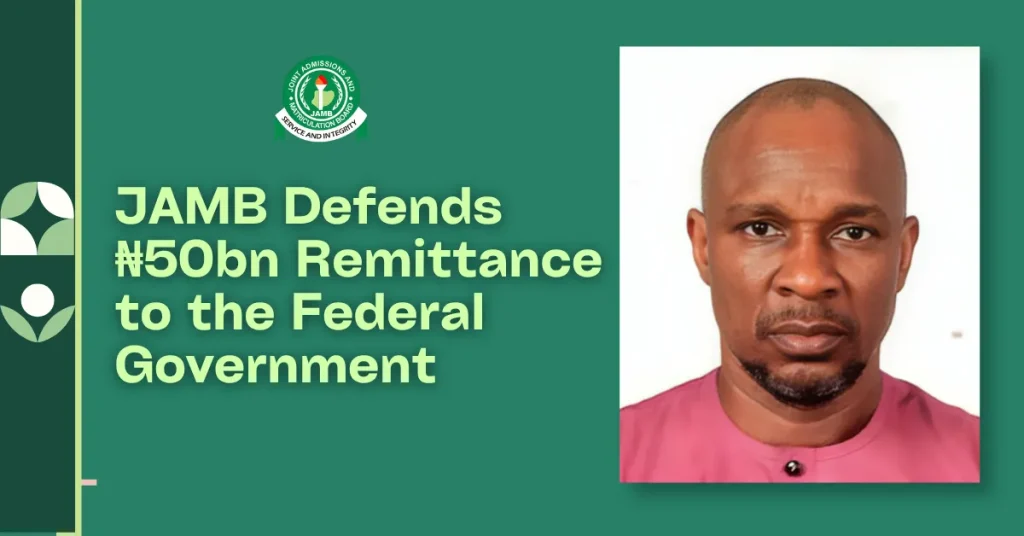
JAMB’s Public Communication Adviser, Dr Fabian Benjamin, has clarified that the board’s remittance of over ₦50 billion as operating surplus to the Federal Government over the past 10 years should not be interpreted as evidence that the examination body was created to generate revenue.
Speaking during a dialogue organised by the Education Writers’ Association of Nigeria via Zoom, themed “2026 Admission Policy Review and JAMB Scorecard: A Conversation with the Registrar,” Benjamin explained that the remittances were made in compliance with government regulations requiring all agencies, whether revenue generating or not, to remit a percentage of their excess surplus. “There is an impression that JAMB has become a revenue generating agency. It is not,” he stated, adding: “What JAMB is doing is not out of place. It is part of the rule.”
The dialogue also reviewed Prof Ishaq Oloyede’s decade long tenure as Registrar, which concludes on 31 July 2026, with Prof Segun Aina set to resume office on 1 August 2026. Benjamin credited much of the board’s financial savings to technological reforms introduced under Oloyede, particularly the replacement of satellite based connectivity for examinations with a telecoms based system using SIM cards. He recalled that the previous system cost about ₦1.2 billion annually, while the new platform costs less than ₦100 million, noting that service providers had declined requests to lower their charges before the board switched to telecom operators.
Despite the savings recorded, Benjamin disclosed that the current UTME registration fee of ₦3,500 may require a review given rising operational costs. The fee was last adjusted in 2018, when it was reduced from ₦5,000 following efficiency gains. “As I speak with you, there is a debate on whether that is still practicable because of the rising cost of things. I will not be surprised if the fee is likely to go up again,” he stated.
Benjamin maintained that JAMB’s charges remain among the lowest globally for any examination body, explaining that part of the fee paid by candidates is shared with accredited Computer Based Test centres, most of which are privately owned. He noted that many centre operators have complained that payments received no longer reflect the rising cost of diesel and other operational expenses, adding that any future fee adjustment would be driven by economic realities rather than a deliberate push for higher revenue.
He further pointed to innovations such as mock examinations, computer based testing and biometric verification as reforms that have significantly curbed impersonation and other forms of examination malpractice during Oloyede’s tenure.
Last Updated on June 30, 2026 by Ola Funmilayo

With over a decade of experience in education journalism, JAMB-GOV.ORG has become a trusted voice in providing relevant and comprehensive JAMB news reporting that matter most to students and educators nationwide.