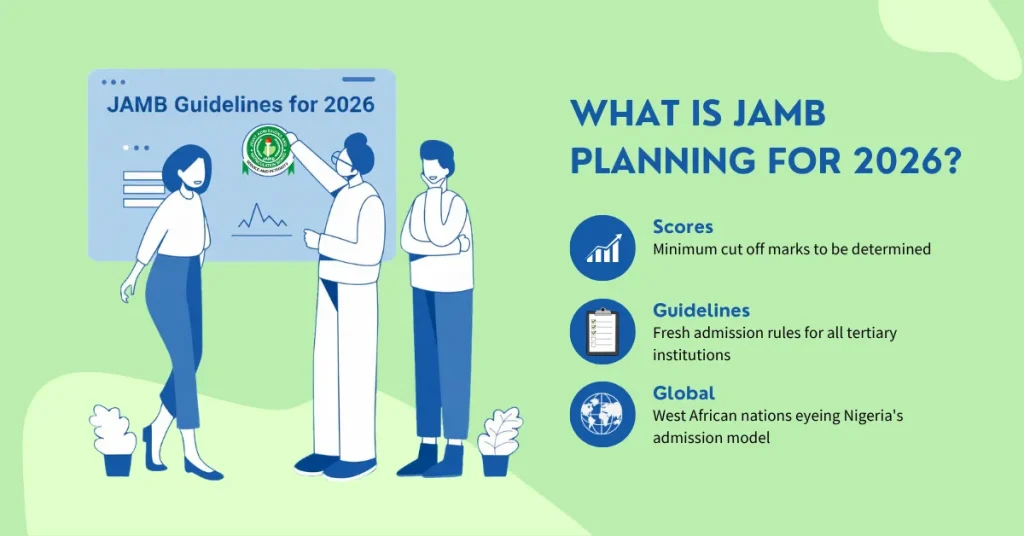
Nigeria’s admission policy meeting for 2026 opened on Monday under the chairmanship of the Minister of Education, Tunji Alausa, with the gathering drawing rare international attention after Sierra Leone sent a delegation to Abuja to study how JAMB coordinates tertiary institution admissions across the country.
The annual meeting, which brings together heads of universities, polytechnics, and colleges of education from both public and private sectors, was set to consider and adopt guidelines for the 2026 admission exercise, including the determination of minimum tolerable scores for candidates seeking entry into tertiary institutions.
JAMB spokesperson Fabian Benjamin confirmed in a statement that Sierra Leone’s Deputy Minister of Education, Sarjoh Aziz Kamara, was part of the delegation present in Nigeria, accompanied by Professor Edwin Momoh, Vice Chancellor of Ernest Bai Koroma University of Science and Technology, and Professor Bashiru Koroma, Vice Chancellor of Njala University.
Benjamin noted that the delegation had been taken through the board’s examination and admission processes at JAMB headquarters in Bwari, Abuja, on Sunday, a day before the policy meeting. “During tomorrow’s Policy Meeting, they will also witness firsthand how critical stakeholders are actively carried along in the admission value chain,” he stated.
The Sierra Leonean officials reportedly expressed appreciation to JAMB, acknowledging that rising admission numbers in their country had created serious coordination challenges that Nigeria’s centralised model appeared positioned to address. Sierra Leone is working towards establishing a body similar to JAMB to streamline admissions into its own tertiary institutions.
Benjamin also used the statement to respond to critics who have repeatedly called for the dissolution of the board, pointing to Sierra Leone’s interest as evidence of its institutional value. “Indeed, one can only imagine what Nigeria’s admission system would have looked like without JAMB. Those clamouring for the scrapping of the Board may better appreciate its strategic importance should such a situation ever arise,” the statement reads.
JAMB has in recent times faced sustained criticism over examination technical failures, registration costs, and concerns around transparency in its admission processes.
Last Updated on May 11, 2026 by Ola Funmilayo

With over a decade of experience in education journalism, JAMB-GOV.ORG has become a trusted voice in providing relevant and comprehensive JAMB news reporting that matter most to students and educators nationwide.