
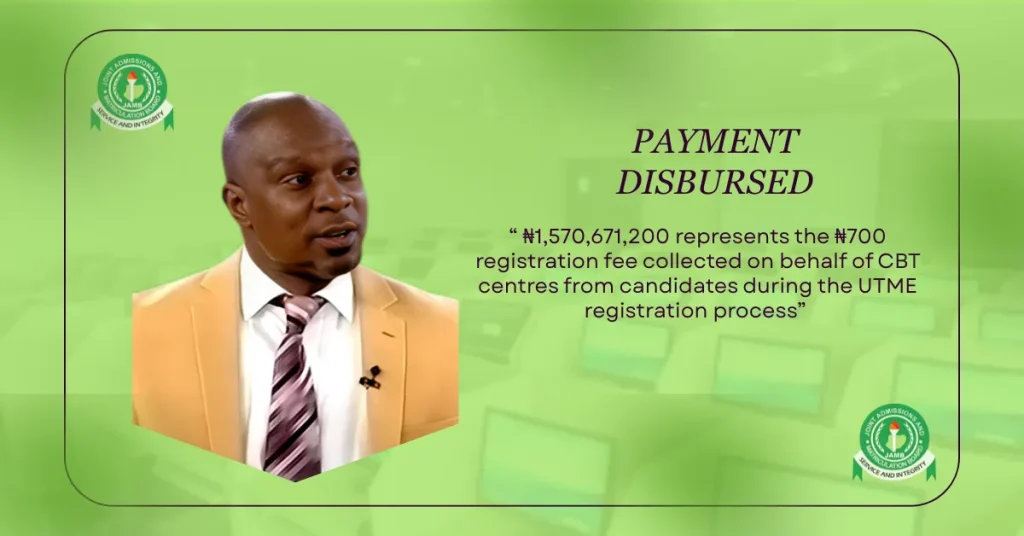
The Joint Admissions and Matriculation Board has disbursed ₦1,570,671,200 to accredited Computer Based Test centres that participated in the 2026 Unified Tertiary Matriculation Examination registration exercise, according to a bulletin released on Monday.
Fabian Benjamin, Public Communication Advisor of JAMB, disclosed in the bulletin that the payment represents the ₦700 registration fee collected on behalf of CBT centres from candidates during the UTME registration process, which the board remits weekly alongside ePIN registration charges.
“In line with this arrangement, the Board has remitted a total sum of ₦1,570,671,200 to the CBT centres that participated in the 2026 UTME registration exercise,” the bulletin stated.
JAMB explained that candidates who purchase the UTME ePIN are not required to make separate payments at CBT centres and can register at any accredited centre of their choice under the cashless registration system.
Austin Ohaekelem, President of the Computer Based Test Centres Proprietors Association of Nigeria, however, described the ₦700 charge as “grossly inadequate” amid rising operational costs and logistical challenges.
“The cost of registering a candidate as of 2016, when I joined the CBT programme, was ₦700. Ten years later, it is still ₦700. This is apart from additional requirements, stipulations that change almost every year, and the logistics and tools we need to run these centres. You and I know the cost of living and the inflation rate, yet we are still being asked to charge ₦700,” Ohaekelem stated.
He highlighted operational constraints faced by CBT centres, noting that a laptop capable of serving for three years costs at least ₦150,000, adding that centres must pay staff, diesel, rent, service equipment, and repairs.
“In Lagos, a 250 capacity hall will cost no less than ₦3 million per year; in Ebute Metta, my centre can’t go below ₦5 million annually. By the time you account for staff and fuel, the N700 registration fee barely covers costs,” Ohaekelem explained.
He added that centres are not allowed to collect the fee directly from candidates, with JAMB refunding the money weekly after centres pay the board first.
JAMB noted that its cashless registration system has reduced abuses, curtailed unauthorised charges, and enhanced transparency, particularly in privately owned centres, implementing a “No View, No Pay” policy under which payments to centres are withheld if registration activities cannot be monitored remotely from its Abuja headquarters.
Last Updated on March 11, 2026 by Ola Funmilayo

With over a decade of experience in education journalism, JAMB-GOV.ORG has become a trusted voice in providing relevant and comprehensive JAMB news reporting that matter most to students and educators nationwide.

